A Living Map by Fred Adam and Geert Vermeire, Locative Media Supercluster NGO An ongoing selection of thinkers, artists, writers, scientists, educators, ecologists and naturalists in our radar.

Ecological
Intelligence

The capacity to perceive, understand, and participate in the intelligence that weaves all living systems — a form of knowing that every non-industrial culture has always practiced, and that modern thinkers are now urgently rediscovering.

Explore

“I believe nature holds deep wisdoms and shares them with the organisms that are willing to listen, imbibe, and take co-creative risks with this intelligence.”

Dr. Rich Blundell — Oika / Beautiful Futures Lab

From consumer choice
to the intelligence of the biosphere

The term "ecological intelligence" has been used across radically different traditions — but all converge on one idea: that intelligence is not exclusively human. It is relational, distributed, and embedded in the living fabric of the Earth. The trajectory of the concept moves from humans knowing about ecosystems toward humans recognizing themselves as expressions of an intelligence already present in nature.

Phase 1 — Consumer Ecology

Ecological intelligence as knowing the hidden impacts of what we buy — a prosthetic for a civilization that has lost its native ecological literacy. The most visible popular approach (Daniel Goleman, 2009).

Phase 2 — Psyche and Wilderness

Ecological intelligence as evolutionary depth — the history of every living creature is within us. A psychiatrist and wilderness guide's vision (Ian McCallum, 2005), predating Goleman by four years.

Phase 3 — Systems & Deep Ecology

Intelligence as a property of living systems — the pattern that connects. Gregory Bateson's "mind in nature," Fritjof Capra's web of life, and Arne Næss's deep ecology — intelligence is distributed, relational, and ecological at every scale.

Phase 4 — Nature's Own Intelligence

The most radical inversion: ecological intelligence is not something humans have — it is what the living Earth is, and what humans can re-participate in. Rich Blundell's Oika, Andreas Weber's Enlivenment, Robin Wall Kimmerer's grammar of animacy. The intelligence was never ours to develop — we are expressions of it.

Key Moments in the Concept's Development

1962

Rachel CarsonSilent Spring

Marine biologist and nature writer Rachel Carson published the book that launched the modern environmental movement. Documenting how pesticides — especially DDT — were moving through food chains and silencing the birds, Carson made ecological intelligence a matter of public urgency. The bald eagle and osprey were rescued from extinction by the laws her writing helped pass.

Foundational discovery
1965

Rachel CarsonThe Sense of Wonder

Published posthumously in 1965 (Carson died in 1964), this short lyrical book grew from an essay she wrote for her young nephew Roger. Its central argument is that a child who keeps their sense of wonder alive — nurtured by at least one adult willing to share it — is protected for life against boredom, disenchantment, and alienation from the living world. "If a child is to keep alive his inborn sense of wonder," she wrote, "he needs the companionship of at least one adult who can share it." A foundational text for ecological intelligence as an embodied, sensory, relational capacity rooted in childhood.

Foundational text
1967

Lynn MargulisOn the Origin of Mitosing Cells

Published in the Journal of Theoretical Biology under her then-name Lynn Sagan (age 29), after being rejected by over fifteen scientific journals. Margulis proved that the key organelles of every living cell — mitochondria and chloroplasts — were once free-living bacteria that merged with other cells in a permanent symbiotic embrace called symbiogenesis. The engine of evolution, she showed, is not only competition but cooperation and merger. Every cell in every body on Earth carries this ancient bacterial community within it. The theory was largely ignored for a decade, then became one of the central discoveries of 20th-century biology — a foundational proof that intelligence in life is collaborative at its very core.

Foundational discovery
1972

James LovelockGaia: A New Look at Life on Earth

Working as an independent scientist and NASA consultant on the search for life on Mars, Lovelock noticed something extraordinary: Earth's atmosphere is wildly out of chemical equilibrium — maintained in that improbable state by the activity of living organisms themselves. He named this self-regulating planetary system Gaia, after the Greek Earth goddess, proposing that the entire biosphere, oceans, atmosphere and rocks form a single living, self-regulating entity. The book, co-developed with novelist William Golding who suggested the name, launched one of the most radical and contested ideas in the history of science.

His colleague Lynn Margulis joined the development of Gaia Theory, providing the microbiological evidence. Together they reframed the Earth not as a backdrop for life, but as a living system produced by life itself — the planet as superorganism, breathing, self-correcting, intelligent at a geological scale.

Foundational discovery
1972

Gregory BatesonSteps to an Ecology of Mind

Foundational: "The pattern which connects." Mind as an ecological process. Intelligence is not inside the skull — it is the pattern of relationships between organism and environment.

1979

Gregory BatesonMind and Nature: A Necessary Unity

"The difference that makes a difference" — information and mind are properties of the living world, not of brains alone.

1983

Jon Young founds Wilderness Awareness School

Begins a 40-year research program into why some cultures consistently produce nature-connected humans. Develops bird language and the 8 Shields model. Over 1,000 nature connection projects worldwide would follow.

1983

Howard Gardner — Theory of Multiple Intelligences

Frames intelligence as plural. In 1995 adds "Naturalist Intelligence" — the capacity to recognize and categorize patterns in the living world. Becomes a direct precursor to Goleman's concept.

1990

Schumacher College Founded (Devon, UK)

Co-founded by Satish Kumar and Stephan Harding. Becomes the most important hub for ecological thinkers: James Lovelock, Lynn Margulis, Arne Næss, Fritjof Capra, Vandana Shiva, David Abram, Andreas Weber.

1996

David AbramThe Spell of the Sensuous

Human cognition is ecologically embedded. Alphabetic writing severed our sensory bond with the living Earth. The "more-than-human world" has its own languages, to which we must re-attune.

1996

Fritjof CapraThe Web of Life

Synthesizes systems theory, Gaia, autopoiesis, and deep ecology into a unified framework. Living systems are networks of relationships — intelligence is a property of these webs, not of isolated nodes.

1999

Thomas BerryThe Great Work

"The universe is the primary teacher." Coins "Ecozoic Era" — a future in which humans participate in Earth's community rather than exploit it. Foundational to Rich Blundell's Big History framing of ecological intelligence.

2000

Elisabet SahtourisEarthDance: Living Systems in Evolution

Evolution biologist and futurist (living in Spain) argues that evolution is a maturation process — from competition to cooperation — visible in bacteria, ecosystems, and civilizations alike. Her butterfly/imaginal cells metaphor becomes one of the most widely circulated ideas in ecological transformation: hidden cells inside the dying caterpillar carry the genome of the butterfly, just as "imaginal cell" humans carry the vision of a regenerative civilization within the collapsing old system.

2005

Ian McCallumEcological Intelligence: Rediscovering Ourselves in Nature

First book with this exact title. A psychiatrist, Jungian analyst, and wilderness guide argues that the evolutionary history of every living creature lives within us. Predates Goleman by four years.

First book with this title
2009

Daniel GolemanEcological Intelligence

Mainstreams the term. Ecological intelligence as radical transparency in consumer behavior — knowing the hidden ecological lifecycle of what we buy. Connected to the Center for Ecoliteracy and industrial ecology.

Popular breakthrough
2009

C.A. BowersEducating for Ecological Intelligence

Ecological intelligence as a pedagogical project. Draws on Bateson to argue that Western education systematically suppresses the capacity to perceive ecological relationships. Calls for a shift from "individual intelligence" to "ecological intelligence" in curricula.

2012

Anna BreytenbachThe Animal Communicator (documentary)

South African interspecies communicator and conservation activist, trained in wildlife tracking by Jon Young. The 2012 NHU Africa documentary — directed by Craig Foster — captures her most celebrated encounter: communicating with a black leopard named Diablo, who had been abused, isolated, and refused to leave his shelter for six months. Through silent mental projection of images and thoughts, Breytenbach received his concerns, conveyed reassurance, and the leopard emerged — renamed Spirit by his keepers. Her conservation work spans cheetahs, lions, wolves, baboons, elephants, whales, and dolphins. She believes interspecies communication is not a special gift but a dormant human capacity — ecological intelligence expressed as listening.

2013

Robin Wall KimmererBraiding Sweetgrass

Indigenous and scientific knowledge braided together. The "grammar of animacy" — languages that treat other species as subjects with agency embed ecological intelligence in their very structure. Awakening ecological consciousness through reciprocity.

2015

Andreas WeberBiology of Wonder

"Poetic ecology" and "Enlivenment": all living beings are feeling, creative agents. Intelligence is not a human monopoly — organisms at every scale experience, feel, and create meaning. Biology must be the study of the feeling self.

2019

Tyson YunkaportaSand Talk

Indigenous thinking as a corrective to extractive modernity. Humans as a "custodial species" with ritual and psychological technologies for working holistically with landscape intelligence. Pattern-based cognition as ecological literacy.

2026

Sarah Fontaine — Interspecies Communication & Wildlife Tracking

Wildlife tracker, interspecies communicator, and nature connection facilitator with over 25 years of practice. Trained in wildlife tracking through Shikari Tracker Mentoring with Jon Young and Tom Brown Jr.'s Tracker School. Her approach weaves neuroscience, somatic trauma integration, polyvagal theory, and energy awareness into nature connection — teaching "Primal Communication" and "Wildlife Tracking for Connection." Co-leads immersive nature retreats with Jon Young. Currently teaching online at sarahfontaine.com.

Ongoing

Rich Blundell — Oika Philosophy

25+ years of field ecology across six continents. Oika: the relational intelligence of nature expressed through human thought and action. The intelligence that builds galaxies and grows forests lives in each of us. Humans can participate in — not just observe — the ecological intelligence of the living world.

Most expansive formulation

Who shaped the concept

Organized by tradition. Names link the idea to its intellectual home.

Books Titled
"Ecological Intelligence"

  • Ian McCallum 2005
    Psychiatrist · Jungian analyst · wilderness guide · poet · South Africa
  • Daniel Goleman 2009
    Psychologist · science journalist · USA · mainstream popularizer

Pioneering Ecology

  • Rachel Carson 1907–1964
    Marine biologist · nature writer · Silent Spring (1962) · The Sense of Wonder (1965) · founded the modern environmental movement

Living Systems Philosophy

  • Rich Blundell
    Ecologist · PhD Big History · Oika founder · Beautiful Futures Lab
  • Thomas Berry
    "Geologian" · Ecozoic Era · Universe Story · 1914–2009
  • Elisabet Sahtouris b. 1936
    Evolution biologist · futurist · EarthDance · imaginal cells · living in Spain

Schumacher College Network

  • Satish Kumar — Co-founder, Gandhian ecological ethics
  • Stephan Harding — Gaian Science, Deep Ecology Fellow
  • Fritjof Capra — Systems view, Web of Life, Center for Ecoliteracy
  • James Lovelock 1919–2022
    Independent scientist · NASA consultant · Gaia Theory · Daisyworld · Earth as living superorganism
  • Lynn Margulis — Endosymbiosis, cooperative evolution
  • Arne Næss — Deep ecology, biospheric Self-realization
  • David Abram — Phenomenology, more-than-human world
  • Vandana Shiva — Biodiversity of the mind, ecofeminism
  • Andreas Weber — Poetic ecology, Enlivenment
  • Brian Goodwin — Holistic biology, morphogenesis

Nature Connection & Tracking

  • Jon Young — 8 Shields, bird language, Wilderness Awareness School
  • Tom Brown Jr. — Master tracker · Jon Young's mentor
  • Anna Breytenbach
    Interspecies communicator · conservation activist · South Africa · trained with Jon Young · animalspirit.org
  • Sarah Fontaine
    Wildlife tracker · interspecies communicator · nature connection facilitator · studied with Jon Young · sarahfontaine.com

Education & Measurement

  • C.A. Bowers — Critical pedagogy, cultural commons, eco-intelligence in education
  • Emel Okur-Berberoglu — Ecological Intelligence Measurement Tool
  • Nakiye Akkuzu — Ecological Intelligence Scale (41 items)
  • Howard Gardner — Multiple Intelligences, Naturalist Intelligence

Indigenous Wisdom

  • Robin Wall Kimmerer — Botanist · Potawatomi Nation · grammar of animacy
  • Tyson Yunkaporta — Aboriginal scholar · custodial species · Sand Talk
  • San Bushman elders (collaborating with Jon Young's Living Connection 1st Village)

Cognitive Science & Meaning

  • John Vervaeke — Recursive relevance realization, participatory knowing, dialogue with Rich Blundell
  • Gregg Henriques — UTOK, "Cultivating Ecological Intelligence" (with Blundell)
  • Joanna Macy — Work That Reconnects, The Great Turning, Buddhist deep ecology

Systems Thinking Foundation

  • Gregory Bateson — "The pattern which connects" · mind as ecology · 1904–1980

Each thinker —
their companion species

Every ecological thinker arrives at their ideas through a specific encounter with the living world. These are the animals, plants, and fungi that shaped their thinking, appear in their key works, or sparked the original revelation.

🦅
Osprey & Tidal Pool
Pandion haliaetus / intertidal zone
Rachel Carson Marine Biology / Nature Writing (1907–1964)

Carson's two defining encounters: the osprey and bald eagle, whose eggshells were being thinned to breaking point by DDT — the discovery that made Silent Spring (1962) the founding document of the environmental movement. And the rocky tidal pool at the Maine coast, where she and her nephew Roger knelt together at night with a flashlight, watching ghost crabs, hermit crabs, and the sea itself breathe. The Sense of Wonder (1965) was born from those shoreline nights. "Those who dwell among the beauties and mysteries of the earth are never alone or weary of life," she wrote. For Carson, wonder was not sentiment — it was the ecological intelligence of the body tuned to the living world.

🐟
Bluefin Tuna
Thunnus thynnus
Rich Blundell Oika / Big History

The origin moment of Oika. On a commercial fishing trawler on Stellwagen Bank, Blundell hooked an 800-pound bluefin tuna. Looking into the fish's dying eye, the tuna "spoke" to him — rekindling a childhood affection for nature and turning him away from industrial fishing. This encounter is the founding story of his entire life's work.

🐦
American Robin
Turdus migratorius
Jon Young 8 Shields / Bird Language

The robin is the emblem of Young's entire method. His book What the Robin Knows uses robin alarm calls as a key to reading the whole forest's state. Five vocalizations — songs, companion calls, territorial aggression, adolescent begging, alarms — form a living language anyone can learn. The robin broadcasts the intelligence of the entire landscape.

🌿
Sweetgrass
Hierochloe odorata (wiingaashk)
Robin Wall Kimmerer Potawatomi / Botany

Sweetgrass — wiingaashk in Potawatomi — is the central metaphor of Braiding Sweetgrass. Sacred hair of Mother Earth, pioneer healer of broken land, ceremonial plant. Kimmerer braids it as she braids her book's three strands: indigenous wisdom, scientific knowledge, and the teachings of plants. Its vanilla fragrance is the scent of reciprocity.

🌲
Douglas Fir & Paper Birch
Pseudotsuga menziesii / Betula papyrifera
Suzanne Simard Forest Ecology

Simard's landmark 1997 Nature paper showed these two trees sharing sugars through mycorrhizal networks — the birch sending surplus carbon to the fir in summer, the fir returning it in winter. Their partnership demolished the idea of the competitive forest and revealed trees as a community of mutual care with its own form of intelligence.

🐬
Dolphin & Octopus
Tursiops truncatus / Octopus vulgaris
Gregory Bateson Cybernetics / Ecology of Mind

Bateson's research on dolphin communication and octopus learning was central to his ecology of mind. The dolphin's capacity for meta-communication — communicating about communication — inspired his concept of logical types and double-bind theory. He studied these species at the Communication Research Institute, building toward his vision of mind as an ecological process.

🐘
African Elephant
Loxodonta africana
Ian McCallum Ecological Psychology / Wilderness

McCallum's project "In the Tracks of Giants" traced a 5,000-km journey through elephant corridors across Namibia, Botswana, Zambia and South Africa. The elephant — ancient, socially complex, emotionally intelligent, mourning its dead — embodies his vision of the evolutionary intelligence that lives within every human psyche. He writes of elephants as teachers of grief and memory.

🌾
Rice, Wheat & Neem
Oryza sativa / Triticum / Azadirachta indica
Vandana Shiva Ecofeminism / Seed Sovereignty

Shiva's Navdanya has preserved 500 strains of rice and 150 of wheat against corporate biopiracy. The neem tree became emblematic of her most celebrated legal battle: when a US corporation patented neem's fungicidal properties, she fought and won a decade-long legal case, establishing that ancestral plant knowledge cannot be colonized.

🐋
Sperm Whale & Whooping Crane
Physeter macrocephalus / Grus americana
Joanna Macy Buddhist Deep Ecology

Macy's ritual "Bestiary" centers the sperm whale: "Dive me deep, brother whale, in this time we have left. Deep in our mother ocean where once I swam, gilled and finned." The whooping crane, the California condor, the snow leopard — her Work That Reconnects uses specific endangered beings as doorways into ecological grief, not abstract statistics.

🦅
Raven & Alpine Flora
Corvus corax / Dryas octopetala
Arne Næss Deep Ecology / Ecosophy T

Næss developed his "Ecosophy T" from his mountain cabin at Tvergastein, far above the timberline under the whale-shaped Hallingskarvet in Norway. He cultivated a tiny alpine garden in extreme conditions and lived in kinship with the hardy mountain-avens, ravens, and mountain flora of this high-altitude world. Direct encounter with the tenacity of alpine life grounded his philosophy of intrinsic value.

🐊
Crocodile & Turtle
Crocodylus johnstoni / Chelonia mydas
Tyson Yunkaporta Aboriginal Knowledges / Apalech Clan

In Sand Talk, the crocodile is a model of non-linear intelligence: "not an abstract factor in an algorithm, but a sentient being who observed you the first time and will be waiting for you the second time." The turtle appears in the meta-songline connecting all Aboriginal peoples — "it goes everywhere that turtles go, and there are turtles all over the world."

🕷️
Spider & Raven
Araneae spp. / Corvus corax
David Abram Phenomenology / More-than-Human World

In Bali, practising sleight-of-hand magic, Abram entered states of reciprocal attention with spiders — meeting their gaze across a web. This became the opening of The Spell of the Sensuous and the foundation of his phenomenology. He also invokes ravens as co-evolved partners in human verticality — creatures that share our orientation toward the sky.

🍄
Mycorrhizal Fungi
Amanita muscaria / Paxillus involutus
Stephan Harding Schumacher College / Gaian Science

Harding's Gaian science returned again and again to mycorrhizal fungi as the living proof of planetary intelligence — the "wood wide web" as Earth's underground nervous system. His teaching at Schumacher always began in the soil: kneeling, hands in earth, showing students the mycelial threads connecting roots as the most direct encounter with Gaia's self-regulating intelligence.

🦠
Spirochaete Bacteria
Spirochaeta spp. (endosymbiosis model)
Lynn Margulis Evolutionary Biology / Endosymbiosis

Margulis proved that eukaryotic cells arose from symbiosis between ancient bacteria — specifically that spirochaetes became the cilia and flagella of complex cells, while purple bacteria became mitochondria. Every cell in your body carries this cooperative intelligence. She turned Darwinian competition on its head: the engine of complexity is not war, but embrace.

Firefly & Sea Anemone
Photinus pyralis / Actinia equina
Andreas Weber Poetic Ecology / Enlivenment

Weber opens Biology of Wonder with the bioluminescent firefly — a creature transforming chemistry into light, into meaning, into communication — as the paradigm of "aliveness." The sea anemone, which is both plant-like and animal, challenges every categorical boundary and embodies his poetic ecology: every organism an expressive subject co-creating meaning with its environment.

🐆
Black Leopard — Spirit
Panthera pardus (melanistic)
Anna Breytenbach Interspecies Communication / Conservation · South Africa

Trained in wildlife tracking by Jon Young, Breytenbach became world-famous for her encounter with a black leopard named Diablo — abused, isolated, and snarling for six months in a South African sanctuary. Through telepathic communication (silent mental images and thoughts), she relayed his concerns to his keepers and conveyed reassurance. That same afternoon, the leopard walked out of his shelter for the first time — and was renamed Spirit. The documentary The Animal Communicator (Craig Foster, 2012) captured it all. Her conservation work also spans elephants, wolves, baboons, whales, and dolphins. She argues that interspecies communication is not a gift but a recoverable human capacity — ecological intelligence as listening.

🦊
Pale Fox (Divination)
Vulpes pallida
Dogon People of Mali West African Traditional Ecological Knowledge

The Dogon practice fox geomancy (renard pâle): a pale fox leaves tracks overnight in sand trays prepared with food, and the patterns are read as consultation with the fox's intelligence — advising on farming, health, and community decisions. The fox is not a symbol but an active ecological intelligence being directly consulted.

🐾
Wild Kin — Tracked Species
Tracks, trails & interspecies communication
Sarah Fontaine Wildlife Tracking / Interspecies Communication

Fontaine's practice centers on reading the tracks and signs of wild animals as a language of relationship. Trained in the Shikari Tracker Mentoring lineage of Jon Young and Tom Brown Jr., she works with whatever wild kin share her landscape — reading their trails as a form of embodied ecological intelligence. Her "Primal Communication" courses teach students to sense the felt presence of other species through neuroscience, polyvagal theory, and somatic awareness. Website: sarahfontaine.com

The intelligences of other species

A central shift in the ecological intelligence concept is the recognition that intelligence — problem-solving, communication, memory, social coordination, creativity — is not a human monopoly. It is a property of living systems at every scale.

Plant Intelligence

Plants communicate distress through volatile compounds, share nutrients via mycorrhizal networks, remember past attacks and prepare responses. Monica Gagliano's research shows learning and habituation in plants. Stefano Mancuso (plant neurobiologist) argues roots exhibit distributed problem-solving identical in function to neural networks.

"The wood wide web is a market of mutual aid, not competition." — Suzanne Simard

Bird Intelligence — Language and Community

Birds use sophisticated alarm calls with syntax-like structure. Jon Young's research shows bird language as a barometer of ecosystem health — a community-wide intelligence broadcast. Corvids solve multi-step problems, use tools, understand causality and delay gratification. New Caledonian crows manufacture hooked tools.

"What the robin knows is not less than what we know — it is differently shaped, and more finely tuned to what matters here." — Jon Young

Cephalopod Intelligence

Octopuses have two-thirds of their neurons in their arms — a radically distributed nervous system. They solve puzzles, recognize individual humans, play, use tools, and dream (REM-like states with rapid color changes). This intelligence evolved completely independently of vertebrate lineages — it is a parallel invention of mind.

"Evolution discovered minds at least twice. What else might it have found that we haven't noticed?" — after Peter Godfrey-Smith, Other Minds

Cetacean Culture and Cognition

Whales and dolphins have culture — behaviors learned and transmitted socially, not genetically. Sperm whales have structured dialects, regional "clans," and named individuals. Hal Whitehead and Luke Rendell demonstrate that cetacean culture meets all criteria used for human culture. Humpbacks compose evolving songs that spread across ocean basins.

"Culture is not what separates us from other animals. It is what joins us to them." — Hal Whitehead

Fungal Intelligence

Mycelial networks solve optimization problems that parallel human-designed transport networks. Slime molds redesign Tokyo's railway system more efficiently than engineers. Mycorrhizal fungi make "decisions" about resource allocation — channeling nutrients toward trees under stress. Merlin Sheldrake calls this "entangled life" — a form of intelligence without neurons.

"Fungi are everywhere but they are easy to miss. They are inside us, outside us, and between us." — Merlin Sheldrake

Collective / Superorganism Intelligence

Ant colonies make decisions no individual ant can make. Honeybees use waggle dances to encode distance and direction — a symbolic communication system. E.O. Wilson's work on eusocial insects and Deborah Gordon's decades of ant research show emergent intelligence: the colony "knows" things that no ant knows.

"An ant has roughly the same number of neurons as a transistor in a microprocessor. But 100,000 ants together build air-conditioned cities." — Deborah Gordon

Ecosystem-Level Intelligence

Rich Blundell's central thesis: ecosystems themselves are intelligent — they solve the problems of survival, regeneration, and adaptation through relational processes. James Lovelock's Gaia Theory: the entire planetary system self-regulates temperature, chemistry, and conditions for life — a planet-scale intelligence. Stephan Harding called this "Gaian science" — participatory, not observational.

"The intelligence that builds galaxies, grows forests, and creates healthy living systems lives in each of us." — Rich Blundell

Forest Memory

Suzanne Simard's research demonstrated that forests are not collections of competing individuals — they are networks of mutual support. "Mother trees" recognize their own kin, preferentially allocate carbon to their seedlings, and send distress signals across the network before death. The forest has memory encoded in its connections.

"Trees talk. Pay attention." — Suzanne Simard

Cultures still celebrating the intelligence of their environment

Long before the term "ecological intelligence" was coined, many of the world's cultures practiced it as a matter of daily life — honoring, conversing with, and learning from the other species sharing their landscape. These are not historical relics: they are living traditions.

Southern Africa

San / !Kung Bushmen

The oldest continuous culture on Earth. The San maintain a deep tracking intelligence developed over at least 70,000 years — reading the "writing on the ground" to understand the intentions, emotional states, and health of animals. Their epistemology: knowledge belongs to the whole community, not the individual. Jon Young's Living Connection 1st Village collaborates with San elders to transmit this tradition.

Tracking as epistemology Community storytelling Trance healing dances
North America

Potawatomi Nation

The Potawatomi language is 70% verb — most nouns that describe the natural world are animate. "The bay" is said with the same grammatical form as "a person." Robin Wall Kimmerer calls this "the grammar of animacy" — a linguistic structure that embeds ecological intelligence in every sentence. To speak Potawatomi is to acknowledge the personhood of the living world.

Grammar of animacy Seed sovereignty Reciprocal gratitude
Australia

Aboriginal Australian Peoples

Songlines — a network of trails crossing the continent — encode ecological, cosmological and navigational knowledge in song and story. Each person is custodian of a section of country and its species. Tyson Yunkaporta describes the Aboriginal person as a "custodial species" with ritual technologies for maintaining ecological balance. Totemic relationships assign each person a species relative.

Songlines Custodial land care Totem kinship with species
Amazon Basin

Yanomami and Kayapó Peoples

The Yanomami understand the forest as a community of "forest spirits" — an animist epistemology that maps onto modern ecological understanding with remarkable precision. Kayapó agroforesters have maintained complex polycultures for centuries, deliberately cultivating islands of forest with 120+ species managed as interconnected gardens. Their ecological knowledge rivals that of professional ecologists.

Shamanic plant knowledge Forest garden management Multi-species cosmology
Pacific Northwest

Haida and Coast Salish Peoples

The Pacific Northwest traditions encode intricate ecological knowledge in oral literature, totem poles, and ceremony. The potlatch redistributes wealth in a manner that mirrors forest nutrient cycling. Salmon ceremony honors the annual return as a conversation between human and fish communities. The orca, wolf, eagle, and raven are not symbols — they are relatives with their own forms of intelligence.

Salmon ceremony Potlatch redistribution Totem species kinship
Andes / South America

Quechua / Andean Communities

Pachamama (Earth Mother) is not a metaphor — she is a living entity with legal rights (recognized in Ecuador's constitution). The Andean concept of Sumak Kawsay (Buen Vivir / "Good Living") proposes a relational economy in harmony with other species. Andean farmers still practice intricate calendar-reading of plants, animals, and stars to guide agricultural decisions — what they call "reading the bioindicators."

Pachamama (Earth rights) Buen Vivir economics Bioindicator calendar
Japan

Satoyama Communities

Satoyama — the landscape between mountain wilderness and agricultural fields — is managed by Japanese communities with sophisticated ecological knowledge accumulated over centuries. The concept of kodawari (devotion to craft in relationship with natural materials) and satoyama management maintains habitat mosaics that support high biodiversity. Shintoism treats mountains, rivers, and ancient trees as kami — living intelligences deserving respect.

Satoyama habitat mosaics Kami (spirit of place) Seasonal nature festivals
India

Bishnoi Community

The Bishnoi of Rajasthan have protected wildlife and trees for 500+ years based on their religious principles — the 29 rules given by Guru Jambheshwar in 1485 include prohibitions on killing animals and cutting green trees. In 1730, 363 Bishnoi people died defending trees from the Maharaja's woodcutters — the event that inspired Gandhi's non-violence movement and later the Chipko ("tree-hugging") movement. Their intelligence of care has maintained forest and wildlife where nothing else survives in the Thar Desert.

Sacred grove protection Non-violence with species Living with wild animals
Arctic

Inuit and Yup'ik Peoples

Inuit ecological knowledge accumulated over 4,000+ years in one of Earth's most extreme environments. Dozens of words for ice and snow types — a vocabulary that encodes precise navigational and ecological intelligence. Yup'ik oral traditions describe relationships with specific animal persons — individual seals, walruses, caribou — with whom one enters into obligations. Climate change has disrupted this knowledge: elders describe the land becoming "unreadable" as ice conditions change without precedent.

Ice and weather reading Animal personhood Oral ecological memory
West Africa

Dogon People of Mali

The Dogon maintain an intricate cosmology in which Nommo (water spirits) are the intelligent principle of living water. Their agricultural calendar is read through the behavior of specific species — the Pale Fox (Vulpes pallida) leaves tracks in sand trays used for divination, effectively consulting the fox as an ecological intelligence. The Dogon also possess astronomical knowledge of the Sirius binary star system that puzzled 20th-century astronomers.

Fox divination (Geomancy) Ancestral ecological memory Species-based cosmology
Scandinavia

Sámi People

The Sámi of northern Scandinavia and the Kola Peninsula maintain living ecological intelligence through reindeer herding, guided by intimate knowledge of lichen, weather, snow conditions, and reindeer behavior. Their traditional land-use philosophy of siida — cooperative herding units — mirrors the cooperative intelligence of the reindeer herds themselves. Knowledge of when to move, where to graze, how to read the sky belongs to both humans and reindeer.

Reindeer co-intelligence Lichen and snow literacy Siida cooperative herding
Hawaii / Polynesia

Hawaiian and Polynesian Navigation Traditions

Polynesian wayfinders navigate 3,000+ miles across open ocean without instruments — reading stars, waves, swells, wind patterns, bird behavior, cloud formations, phosphorescence, and even the taste of the sea. Mau Piailug (master navigator) called this "reading the conversation between the ocean and the sky." The canoe is understood to be in dialogue with the ocean — an ecological intelligence expressed as navigation.

Star and swell navigation Bird behavior reading Ocean-canoe dialogue

Voices of the
living world

Audio recordings — talks, readings, and field encounters from thinkers in this map.

David Abram
Sensing
Philosopher and ecologist David Abram on perception, language, and the sensuous encounter with the more-than-human world.
Phenomenology More-than-Human World
Sensing — David Abram

A selection of books
by Fred Adam

A personal library at the intersection of ecological intelligence, nature connection, deep ecology, and the more-than-human world.
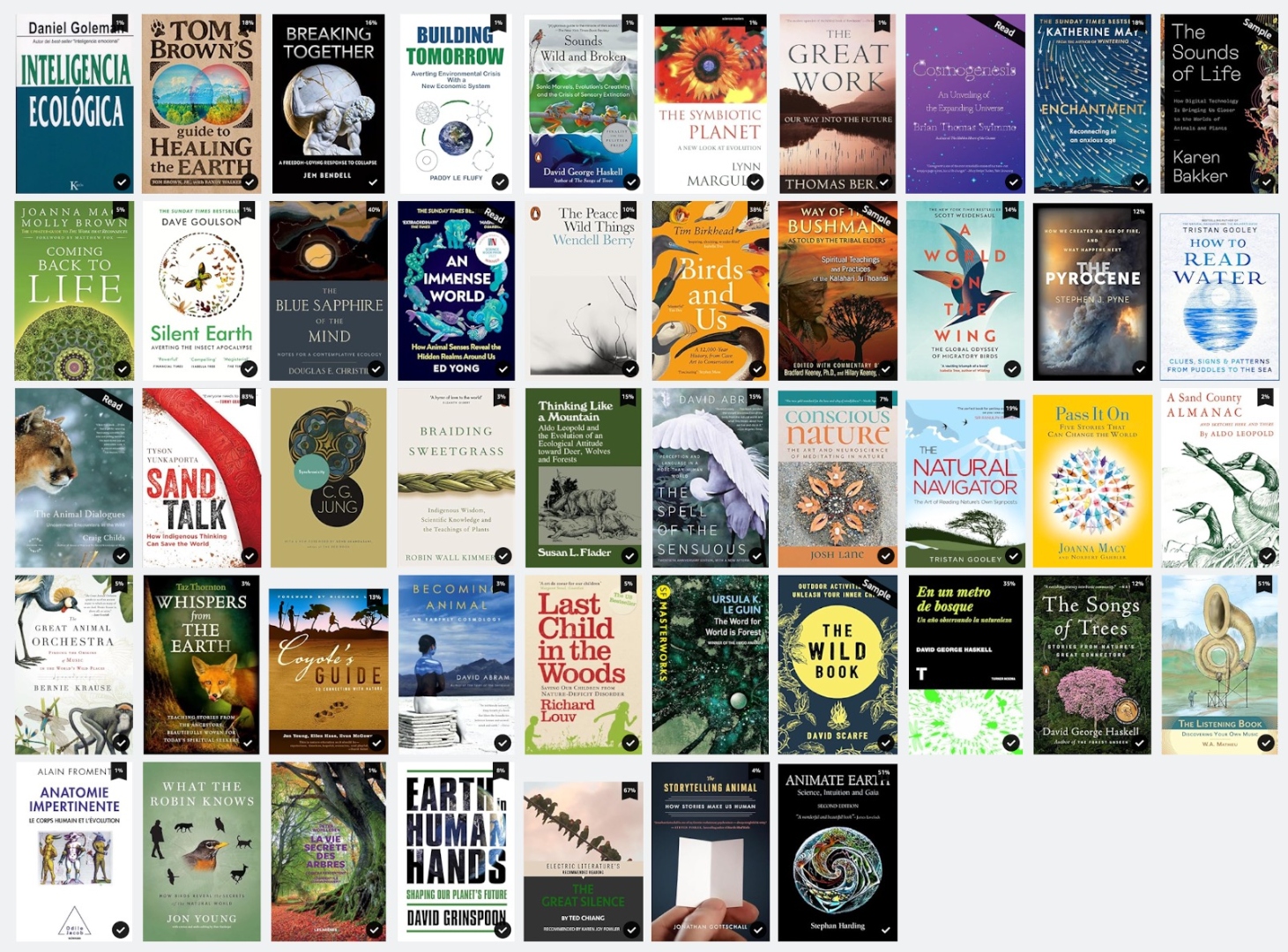
A grid of book covers selected by Fred Adam on ecological intelligence and related themes
01
Inteligencia Ecológica Daniel Goleman
02
Tom Brown's Guide to Healing the Earth Tom Brown Jr.
03
Breaking Together: A Freedom-Loving Response to Collapse Jem Bendell
04
Building Tomorrow: Averting Environmental Crisis With a New Economic System Paddy Le Flufy
05
Sounds Wild and Broken: Sonic Marvels, Evolution's Creativity and the Crisis of Sensory Extinction David George Haskell
06
The Symbiotic Planet: A New Look at Evolution Lynn Margulis
07
The Great Work: Our Way Into the Future Thomas Berry
08
Cosmogenesis: An Unfolding of the Expanding Universe Brian Thomas Swimme
09
Enchantment: Reconnecting in an Anxious Age Katherine May
10
The Sounds of Life: How Digital Technology is Bringing Us Closer to the Worlds of Animals and Plants Karen Bakker
11
Coming Back to Life Joanna Macy & Molly Brown
12
Silent Earth: Averting the Insect Apocalypse Dave Goulson
13
The Blue Sapphire of the Mind: Notes for a Contemplative Ecology Douglas E. Christie
14
An Immense World: How Animal Senses Reveal the Hidden Realms Around Us Ed Yong
15
The Peace of Wild Things Wendell Berry
16
Birds and Us Tim Birkhead
17
Way of a Bushman: Spiritual Teachings and Practices of the Kalahari Ju/ǀhoansi Bradford Keeney & Hillary Keeney
18
A World on the Wing: The Global Odyssey of Migratory Birds Scott Weidensaul
19
The Pyrocene: How We Created an Age of Fire and What Happens Next Stephen J. Pyne
20
How to Read Water: Clues, Signs & Patterns from Puddles to the Sea Tristan Gooley
21
The Animal Dialogues Craig Childs
22
Sand Talk: How Indigenous Thinking Can Save the World Tyson Yunkaporta
23
The Blue Sapphire of the Mind (C.G. Jung) C.G. Jung
24
Braiding Sweetgrass: Indigenous Wisdom, Scientific Knowledge and the Teachings of Plants Robin Wall Kimmerer
25
Thinking Like a Mountain: Aldo Leopold and the Evolution of an Ecological Attitude toward Deer, Wolves and Forests Susan L. Flader
26
The Spell of the Sensuous: Perception and Language in a More-than-Human World David Abram
27
Conscious Nature: The Art and Neuroscience of Meditating in Nature Josh Lane
28
The Natural Navigator: The Rediscovered Art of Letting Nature Be Your Guide Tristan Gooley
29
Pass It On: Five Stories That Can Change the World Joanna Macy & Norbert Gahbler
30
A Sand County Almanac Aldo Leopold
31
Great Animal Orchestra: Finding the Origins of Music in the World's Wild Places Bernie Krause
32
Whispers from the Earth Taz Thornton
33
Coyote's Guide to Connecting with Nature Jon Young, Ellen Haas, Evan McGown
34
Becoming Animal: An Earthly Cosmology David Abram
35
Last Child in the Woods: Saving Our Children from Nature-Deficit Disorder Richard Louv
36
Masterworks (Ursula K. Le Guin — The Word for World is Forest) Ursula K. Le Guin
37
The Wild Book: Unleash Your Inner Eco David Scarfe
38
En un metro de bosque: Un año oberrando la naturaleza David George Haskell
39
The Songs of Trees: Stories from Nature's Great Connections David George Haskell
40
The Listening Book W.A. Mathieu
41
Anatomie Impertinente: Le Corps Humain et l’Évolution Alain Froment
42
What the Robin Knows: How Birds Reveal the Secrets of the Natural World Jon Young
43
La Vie Secrète des Arbres Peter Wohlleben
44
Earth in Human Hands: Shaping Our Planet’s Future David Grinspoon
45
The Great Silence (Electric Literature’s Recommended Reading) Ted Chiang
46
The Storytelling Animal: How Stories Make Us Human Jonathan Gottschall
47
Animate Earth: Science, Intuition and Gaia Stephan Harding

Disclaimer This document is produced by the Supercluster NGO, based on Fred Adam and Geert Vermeire’s knowledge, experience, and human and more-than-human connections. It is part of the ongoing research for the EI Youth project, dedicated to bringing ecological awareness to young people and broader audiences. This document is an ongoing process, partly crafted with the help of AI technology for online research. We believe that Ecological Intelligence (E.I.) and the wise, moderate use of Artificial Intelligence (A.I.) to gather information are compatible, if it benefits a paradigm shift. We always advocate that ecological intelligence is relational, and is the true meaning of “intelligence” (E.I.) — toward a more sustainable, flourishing, and biodiverse world.